
Demystifying the AI Lexicon: A Beginner's Guide to Artificial Intelligence
Have you ever felt like you need a translator just to read the news lately? With terms like "Machine Learning," "Neural Networks," and "Generative AI" dominating headlines, it is easy to feel overwhelmed. The world of Artificial Intelligence is expanding at an unprecedented rate, and with it comes a whole new vocabulary. But fear not! You do not need a Ph.D. in computer science to understand what is going on.
Understanding these core concepts is no longer just for tech enthusiasts; it is becoming essential for navigating our modern world. Whether you are a business professional looking to leverage new tools, a student preparing for the future, or simply a curious individual, grasping these terms will empower you to participate in the conversation.
This guide is designed to break down the most common AI terminology into simple, digestible pieces. We will use relatable analogies and real-world examples to demystify the jargon, making the complex world of AI accessible to everyone.
The Foundational Pillars: AI, ML, and Deep Learning
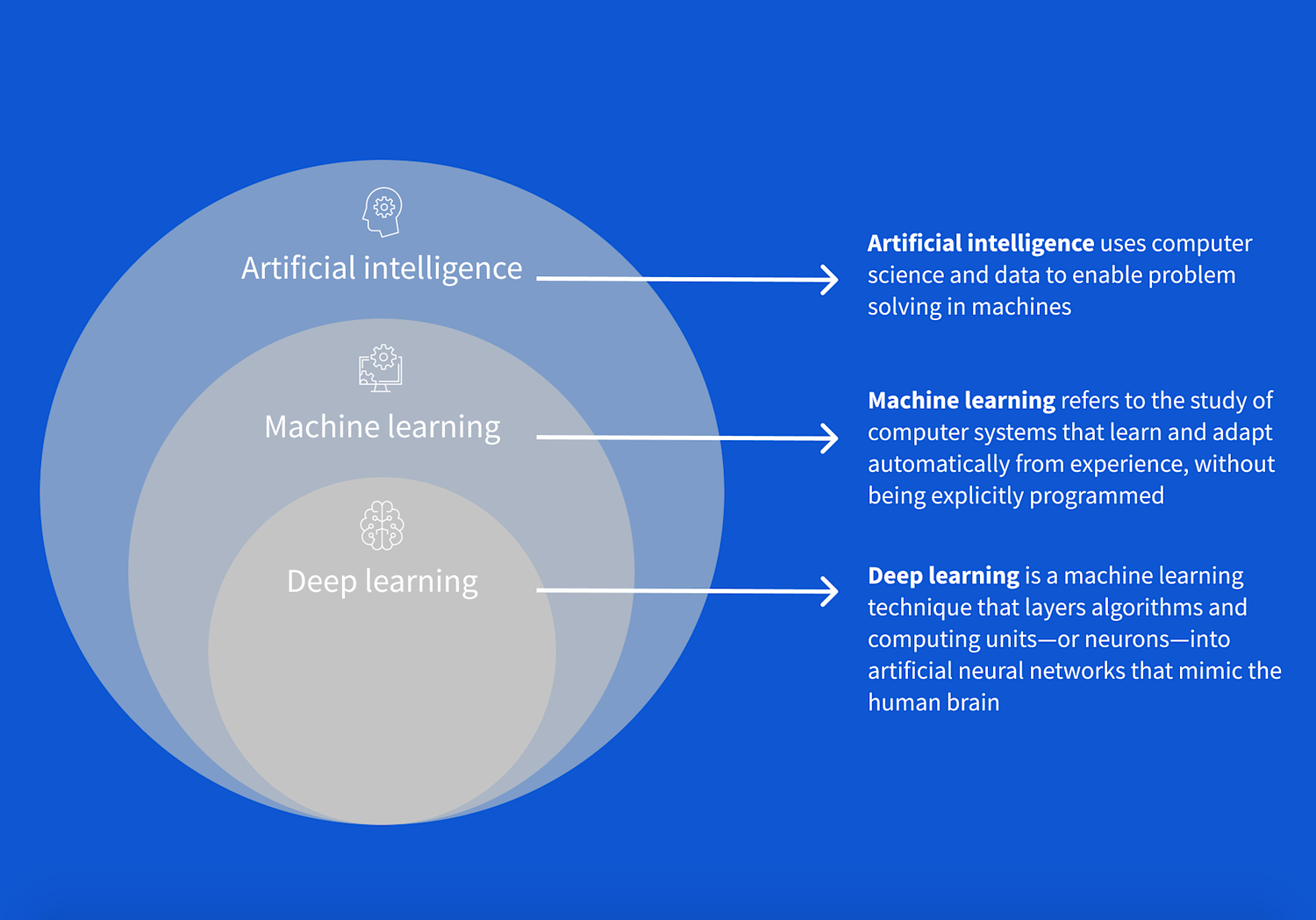
To understand the AI landscape, it is helpful to visualize it as a set of nested circles. At the outermost layer, we have Artificial Intelligence. Inside that is Machine Learning, and nestled within Machine Learning is Deep Learning. Let us explore each of these foundational pillars.
Artificial Intelligence (AI): The Broad Umbrella
At its core, Artificial Intelligence (AI) refers to the simulation of human intelligence processes by machines, especially computer systems. It is the overarching concept of creating machines capable of performing tasks that would typically require human cognitive functions, such as reasoning, problem-solving, and decision-making.
The Analogy: Think of AI as the concept of "building a mechanical brain." Just as a human brain can learn to play chess, recognize faces, or translate languages, AI aims to replicate these abilities in a machine.
Real-World Example: When you ask a virtual assistant like Siri or Alexa to set a timer or check the weather, you are interacting with an AI system designed to understand your voice and execute a command.
Machine Learning (ML): The Learning Engine
Machine Learning (ML) is a specific subset of AI. Instead of explicitly programming a computer with step-by-step instructions on how to perform a task, ML involves feeding the computer large amounts of data and allowing it to learn and identify patterns on its own. The system improves its performance over time through experience.
The Analogy: Imagine teaching a child to identify a dog. You do not give them a strict list of rules (e.g., "must have four legs, fur, and a tail"). Instead, you show them many pictures of dogs and say, "This is a dog." Over time, the child learns to recognize the underlying patterns and can identify a dog they have never seen before. ML works in a very similar way.
Real-World Example: Streaming services like Netflix and Spotify use ML algorithms to analyze your past viewing or listening history. By finding patterns in what you enjoy, they can recommend new movies or songs tailored specifically to your tastes.
Deep Learning: The Neural Network Revolution
Deep Learning is a highly specialized and powerful subset of Machine Learning. It utilizes complex structures called artificial neural networks, which are inspired by the architecture of the human brain. These networks consist of multiple layers of interconnected nodes (neurons) that process information in a hierarchical manner.
The Analogy: Think of Deep Learning as a team of detectives working on a complex case. The first detective looks at the broad strokes (e.g., the shape of an object). They pass their findings to the next detective, who looks at finer details (e.g., edges and textures). This process continues through many layers until the final detective pieces everything together to make a highly accurate conclusion.
Real-World Example: The technology behind self-driving cars relies heavily on Deep Learning. The vehicle's cameras capture images of the road, and deep neural networks process these images in real-time to identify pedestrians, other vehicles, traffic lights, and lane markings, allowing the car to navigate safely.
AI's Senses and Creativity: Vision, Language, and Generation
Now that we understand the foundation, let us look at how AI interacts with the world and creates new things.
Computer Vision: Giving Machines Sight
Computer Vision is the field of AI that enables computers and systems to derive meaningful information from digital images, videos, and other visual inputs. It is essentially giving machines the ability to "see" and interpret the visual world.
The Analogy: It is like teaching a computer to play "I Spy." You show it a picture, and it can identify the objects within it, just as a human would.
Real-World Example: Facial recognition technology used to unlock your smartphone is a prime example of computer vision. The system analyzes the unique features of your face and compares them to the stored data to verify your identity.
Natural Language Processing (NLP): Bridging the Communication Gap
Natural Language Processing (NLP) focuses on the interaction between computers and humans through natural language. It enables machines to understand, interpret, and generate human language in a way that is valuable and meaningful.
The Analogy: Imagine having a highly skilled bilingual interpreter who not only translates words but also understands the context, tone, and intent behind them. NLP strives to be that interpreter between humans and machines.
Real-World Example: Customer service chatbots use NLP to understand your typed questions and provide relevant answers. They analyze the text, determine your intent, and formulate a helpful response, often without human intervention.
Generative AI: The Creative Machine
Generative AI is a type of artificial intelligence that can create new content, such as text, images, audio, and code. It learns the underlying patterns and structures of the data it was trained on and uses that knowledge to generate entirely new, original outputs.
The Analogy: Think of Generative AI as an incredibly talented and versatile artist who has studied millions of paintings, books, and songs. When you give them a prompt, they can draw upon that vast knowledge to create a brand new masterpiece in any style you request.
Real-World Example: Tools like ChatGPT (which generates text) and DALL-E (which generates images) are prominent examples of Generative AI. You can ask ChatGPT to write a poem about a robot learning to love, or ask DALL-E to create an image of a futuristic city on Mars, and they will produce unique results in seconds.
The Mechanics: How AI Actually Works
To truly grasp AI, it helps to understand a few key terms related to how these systems are built and operate.
Algorithms: The Recipe for Success
An Algorithm is a set of step-by-step instructions or rules designed to perform a specific task or solve a particular problem. In the context of AI, algorithms are the mathematical formulas that allow machines to learn from data.
The Analogy: An algorithm is like a recipe for baking a cake. It tells you exactly what ingredients you need and the precise steps to follow to achieve the desired result.
Models: The Trained Brain
An AI Model is the result of running a machine learning algorithm on a dataset. It is the mathematical representation of the patterns and relationships the algorithm discovered during the training process. Once a model is trained, it can be used to make predictions or decisions on new, unseen data.
The Analogy: If the algorithm is the recipe, the model is the experienced baker who has memorized the recipe and can now bake the cake perfectly every time without looking at the instructions.
Training Data: The Fuel for Learning
Training Data is the initial set of data used to teach a machine learning model. The quality and quantity of this data are crucial, as the model learns entirely from the examples it is given.
The Analogy: Training data is like the textbooks and lectures a student uses to prepare for an exam. If the textbooks are outdated or incorrect, the student will not perform well. Similarly, if an AI model is trained on poor-quality data, its predictions will be inaccurate.
The Ethical Dimension: Bias and Hallucinations
As AI becomes more integrated into our lives, it is vital to understand the potential pitfalls and ethical considerations associated with the technology.
AI Bias: The Unintended Prejudice
AI Bias occurs when an AI system produces results that are systematically prejudiced due to erroneous assumptions in the machine learning process. This often happens because the training data itself reflects historical inequalities or human biases.
The Analogy: Imagine a scale that is slightly calibrated to favor one side. No matter what you weigh, the result will always be skewed. Similarly, a biased AI model will consistently produce unfair or discriminatory outcomes.
Real-World Example: If a company uses an AI tool to screen resumes, and the tool was trained primarily on resumes from male applicants, it might inadvertently learn to favor male candidates over equally qualified female candidates.
Hallucinations: When AI Makes Things Up
In the context of Generative AI, a Hallucination refers to an instance where the AI confidently generates false, nonsensical, or entirely fabricated information, presenting it as fact.
The Analogy: It is like a student who did not study for a test but confidently writes down a completely made-up answer, hoping the teacher will not notice. The AI is trying to be helpful, but it lacks the ability to verify the truthfulness of its output.
Real-World Example: You might ask an AI chatbot for a biography of a historical figure, and it might invent a completely fictional event or attribute a quote to them that they never said. This highlights the importance of fact-checking AI-generated content.
Conclusion: Embracing the AI Era
The world of Artificial Intelligence is vast and complex, but understanding its core terminology is the first step toward navigating this exciting new frontier. By demystifying terms like Machine Learning, Deep Learning, and Generative AI, we can move past the jargon and appreciate the profound impact these technologies are having on our society.
AI is not magic; it is a powerful tool built on data, algorithms, and immense computational power. As we continue to integrate AI into our daily lives and workplaces, a foundational understanding of these concepts will empower us to use these tools responsibly, ethically, and effectively. The future is intelligent, and by learning the language of AI, you are well-equipped to be a part of it.