
The Soul in the Machine: Why Human Creativity Still Wins in the Age of AI
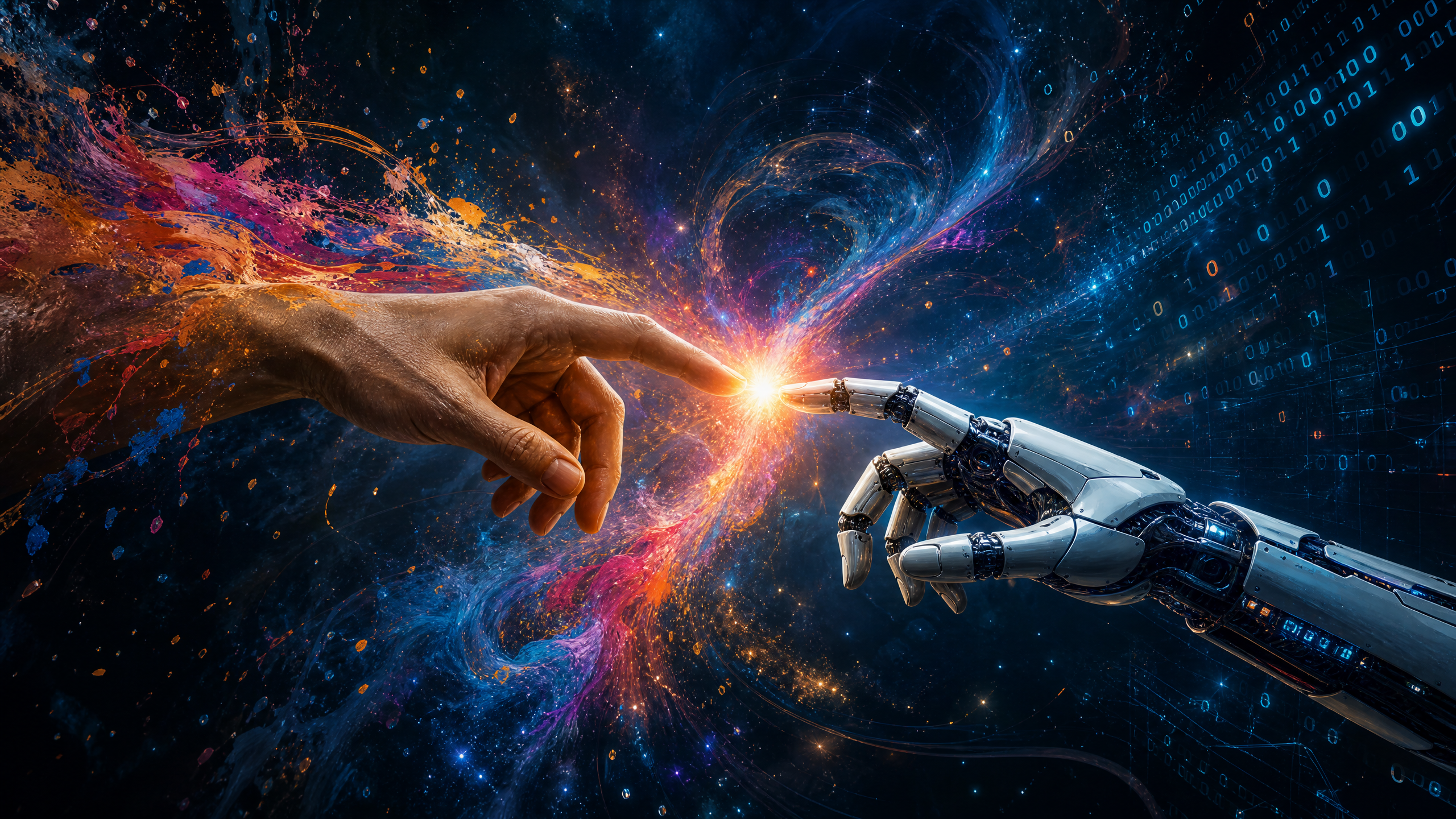
Imagine scrolling through your feed and stopping at a breathtaking digital painting. The lighting is dramatic, the brushstrokes are hyper-detailed, and the composition is flawless. It has thousands of likes and a captivating backstory. But as you stare at it for more than thirty seconds, a strange realization washes over you: you feel absolutely nothing. It is beautiful, technically perfect, and entirely hollow.
This scenario is playing out millions of times a day across the internet. We are living in an era where artificial intelligence can generate symphonies, write essays, design architectural blueprints, and mimic the style of legendary artists in mere seconds. The sheer volume and quality of AI-generated content have sparked a fierce and ongoing debate: In the battle of AI versus human creativity, who truly wins?
While algorithms have mastered the mechanics of creation, the essence of true creativity remains stubbornly human. To understand why, we must look beyond the pixels and the prose to examine the very nature of how and why we create.
The Biological Edge: Why Lived Experience Cannot Be Coded
At its core, artificial intelligence operates on predictive recombination. Models are trained on massive datasets encompassing human history, art, literature, and code. When prompted, they recognize patterns and assemble data points to generate an output that is statistically probable to satisfy the request. It is an extraordinary feat of engineering, but it is fundamentally a process of remixing what already exists.
Human creativity, on the other hand, is born from lived experience. We do not simply remix data; we create from a messy, chaotic well of emotions, scars, traumas, joys, and rebellions. When Pablo Picasso pioneered Cubism, he was not optimizing a dataset of classical paintings. He was making a radical, disruptive break from tradition, responding to the cultural shifts of his time and his own internal evolution.
AI does not wake up one morning and decide it is tired of realism. It does not feel the urge to fracture perspective to express the anxiety of the modern age. It optimizes based on probability. Even when an AI surprises us with a novel combination, it is a statistically derived surprise. When humans surprise the world, it often comes from an act of defiance or a profound emotional revelation.
The Difference Between Synthesis and Invention
To truly grasp the gap, we must distinguish between synthesis and invention. AI is the ultimate synthesizer. It can take the lighting of Caravaggio, the brushwork of Monet, and the subject matter of a cyberpunk novel and fuse them into a single image. This is impressive, but it is a horizontal movement—it expands within the boundaries of what is already known.
Human invention is vertical. It creates new dimensions. Think of the first person who decided to use a distorted guitar sound in rock music, or the first writer to use "stream of consciousness" as a narrative device. These weren't just better versions of existing patterns; they were shifts in the human psyche manifested in art. AI can follow these shifts once they are documented, but it cannot initiate them because it lacks the internal pressure of a soul seeking expression.
The Illusion of Emotion: Simulation vs. Inhabitation
One of the most significant limitations of AI is its inability to genuinely feel. An algorithm can simulate emotion with remarkable accuracy. It can write a breakup poem that follows the structural rules of melancholy, or compose a piece of music in a minor key that sounds inherently sad. But it does not feel heartbreak at two in the morning.
There is a profound difference between analyzing the linguistic patterns of sad songs and sitting on a bedroom floor wondering why someone left. When a human writes about grief, the words are layered with personal memory, physical sensations, cultural context, and irrational contradictions. AI assembles emotion from data; humans bleed it onto the page.
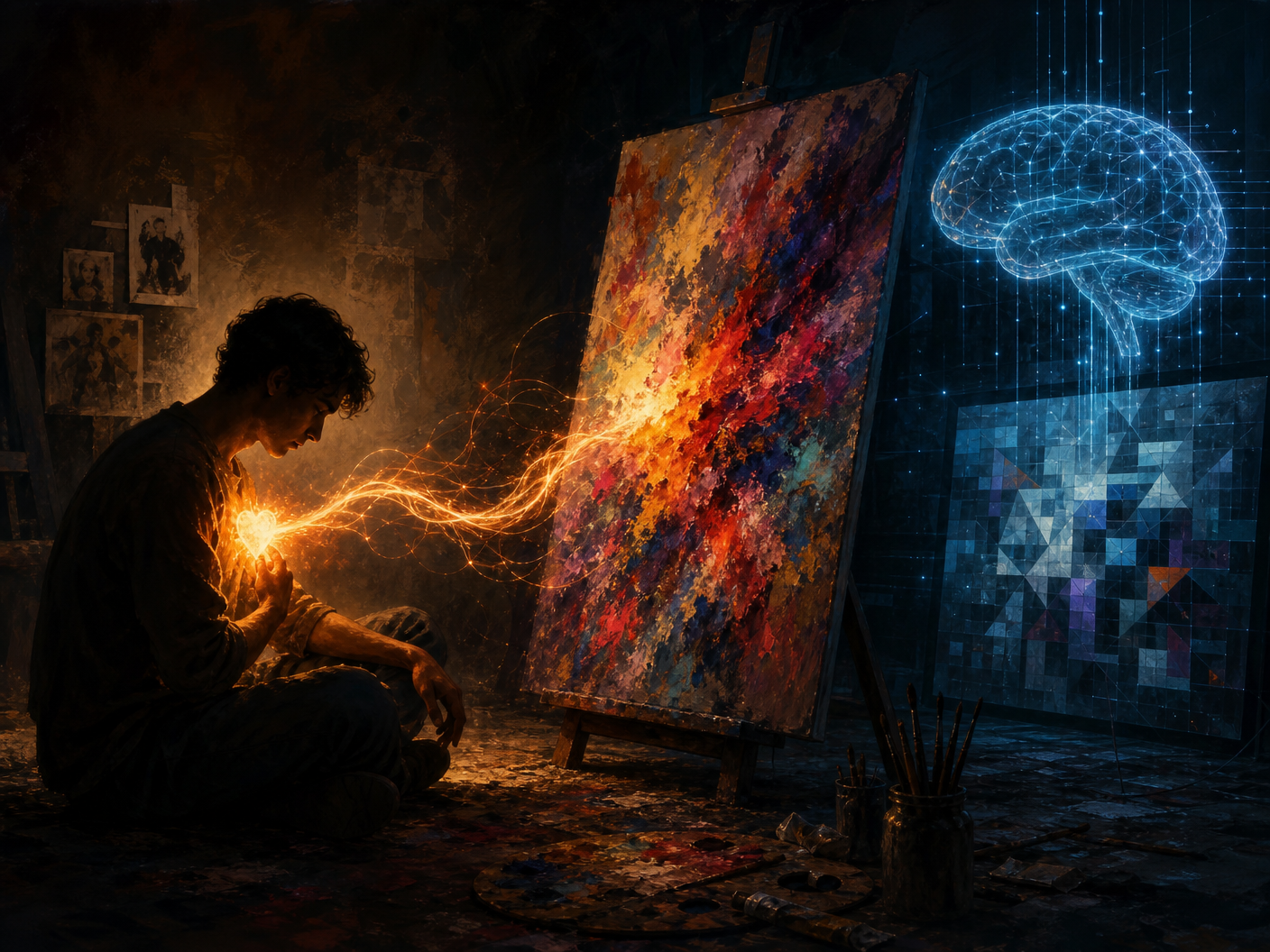
When we consume art, literature, or music, we are not just responding to the technical execution. We are seeking a connection with the soul behind the work. We want to know that someone else has felt the same pain, joy, or confusion that we have. AI can approximate empathy, but it cannot inhabit it.
The "Uncanny Valley" of Creative Output
In robotics, the "Uncanny Valley" refers to the point where a robot looks almost—but not quite—human, causing a sense of revulsion in observers. We are seeing a similar phenomenon in AI creativity. We might read an AI-generated story that is grammatically perfect and hits all the right plot points, yet it feels "off."
This happens because AI lacks the subtle imperfections that signal human presence. Human creators often leave behind "fingerprints"—a slight hesitation in a musical phrasing, an unusual word choice that shouldn't work but does, or a brushstroke that shows the physical pressure of a hand. These "errors" are actually the bridges through which we connect. AI's perfection is its greatest giveaway.
The Magic of Serendipity and the Power of Mistakes
Human creativity thrives on the unexpected. Some of the greatest innovations and artistic breakthroughs have been the result of accidents. A typo that turns into a brilliant brand name, a spilled drop of paint that becomes the focal point of a masterpiece, or a forgotten petri dish that leads to the discovery of penicillin.
Jazz musicians understand this better than anyone. During a live improvisation session, a musician might play a note slightly off-key. Instead of stopping, the band pivots, embracing the "mistake" and turning it into a magical, unrepeatable moment. This is real-time adaptive improvisation, a feat that requires an embodied awareness of the room, the audience, and the other performers.
AI, by design, is optimized to reduce error and ensure consistency. It follows patterns and guardrails to deliver the most accurate result possible. But creativity often emerges from chaos. Humans embrace uncertainty. We experiment recklessly and follow gut instincts that have no basis in data. We allow ourselves to wander off the path, and in doing so, we discover entirely new territories.

The Ethical and Cultural Nuance
Creativity is not just about making something new; it is often about making something meaningful within a specific cultural and ethical context. When a human journalist or filmmaker approaches a sensitive topic, they weigh the cultural impact, historical trauma, and personal responsibility involved in telling that story.
AI does not have values. It has programmed guidelines. It does not wrestle with moral dilemmas or lie awake wondering if its output might harm someone. It lacks the ethical weight that human creators carry. If you ask an AI to write a satirical piece about a sensitive political issue, it might produce something that is technically satire but misses the mark of "punching up" versus "punching down" because it doesn't understand the power dynamics of human society.
Furthermore, AI struggles with deep cultural subtleties. Humor, for example, is highly contextual. A joke that is hilarious in one culture might be deeply offensive or completely nonsensical in another. Sarcasm, inside jokes, regional slang, and political undertones are layered with lived, evolving emotional context. A human writer growing up in a specific neighborhood in Tokyo will carry micro-experiences that shape their voice in ways an algorithm cannot replicate. AI can aggregate data from Tokyo, but it does not inhabit the culture.
The Science of the Spark: What the Research Says
The debate over AI versus human creativity is not just philosophical; it is being studied rigorously by cognitive scientists. Recent research confirms that the "creativity" of AI is largely an optical illusion created by its speed and scale.
A landmark 2026 study led by researchers at the Institute of Neuroscience of the University of Barcelona put this to the test. They compared the visual-creative imagination of human artists, the general public, and AI models. Evaluators judged the outputs based on originality, aesthetics, and emotional resonance. The results were unequivocal: human artists scored the highest by a wide margin, followed by the general public. The AI models, especially when unguided by human prompts, performed the worst.
The researchers concluded that AI creativity is often judged solely on the final product, ignoring the imaginative process. True creativity involves ideation, struggle, and execution. Generative AI models are still far from replicating independent creative processes and rely heavily on human intervention at every stage. In fact, the study found that AI "creativity" is more of a reflection of the human prompter's creativity than the machine's own ability.
From Replacement to Reinvention: The Era of Augmented Creativity
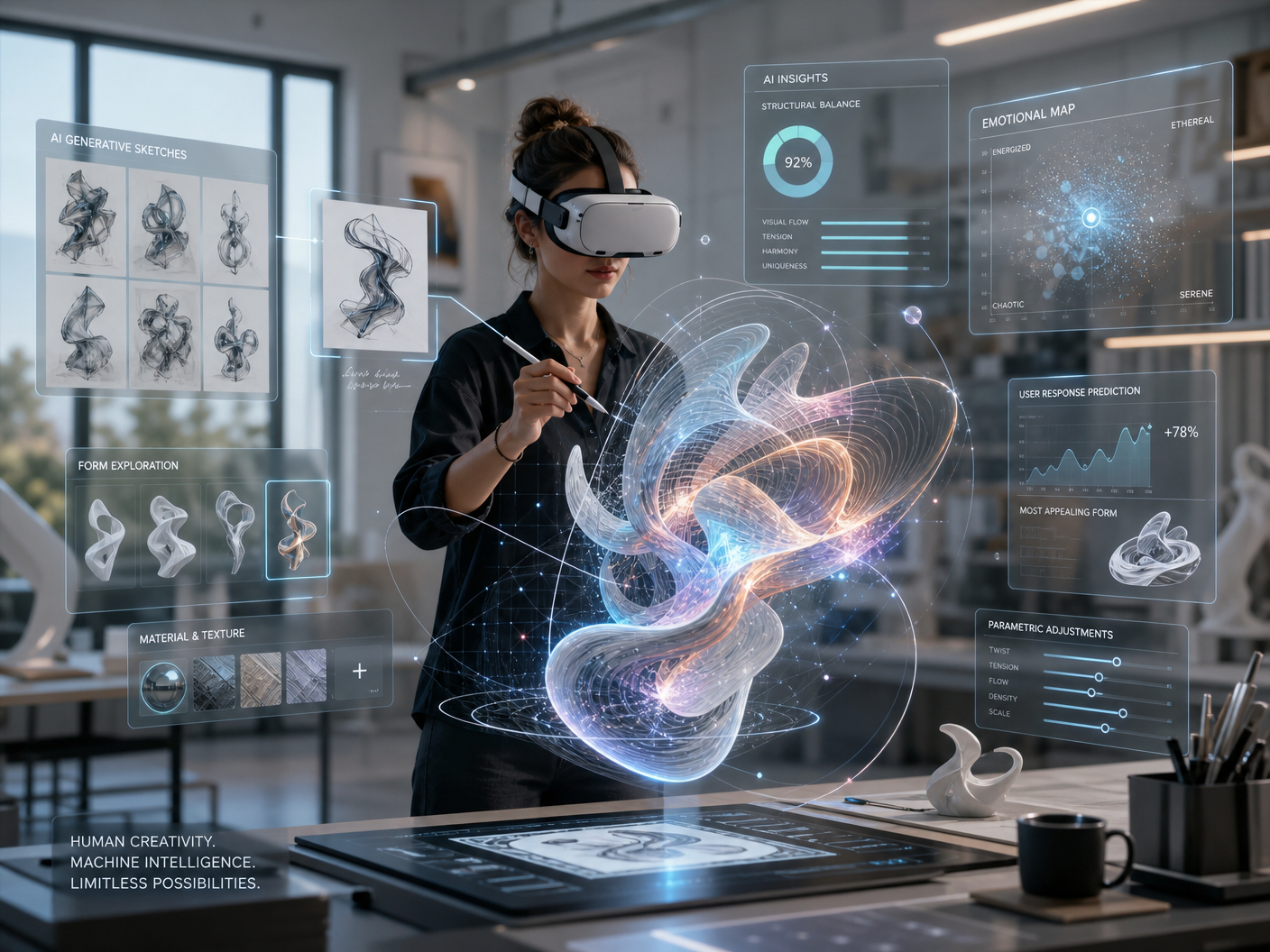
If AI cannot replace the human soul, what is its role in the creative process? The most productive way to view AI is not as a competitor, but as a powerful creative amplifier.
Throughout history, human creativity has been bottlenecked not by a lack of ideas, but by the ability to execute them. The ancient Romans understood the principles of steam power but lacked the materials to build engines. Leonardo da Vinci sketched flying machines centuries before the technology existed to build them.
AI lowers the barrier between conception and realization. It allows a writer to overcome the blank page by generating a dozen rough outlines in seconds. It enables a designer to prototype fifty variations of a logo before lunch. It helps musicians test complex arrangements without needing a full orchestra.
Case Studies in Collaboration
• Architecture: Architects are using AI to generate thousands of structural permutations based on environmental data, allowing them to choose the most sustainable and aesthetically pleasing design. The AI does the math; the human does the dreaming.
• Film Production: Editors use language models to pre-visualize scenes and storyboard complex sequences. This doesn't replace the director's vision; it gives them a clearer lens through which to see it.
• Music: Producers use AI to generate "texture" and background elements, freeing them to focus on the melody and the emotional core of the song.
In these instances, AI does not destroy creativity; it unleashes it. It handles the tedious, repetitive aspects of execution, freeing humans to focus on what they do best: setting direction, selecting the best ideas, and embedding those ideas with meaning and cultural relevance.
The Future of the "Human-Native" Creative
As we move further into the age of algorithms, the creators who will thrive are those who double down on their humanity. The future belongs to those who are both "AI-native" and "human-native."
Being AI-native means understanding how to use these tools to amplify your work. It means knowing how to prompt, iterate, and collaborate with algorithms to work faster and smarter. It’s about treating AI as a highly skilled intern rather than a master.
But being human-native is even more critical. It means cultivating emotional intelligence, ethical judgment, and cultural awareness. It means taking creative risks that an algorithm would flag as statistically improbable. It means telling stories that only you can tell, drawn from your unique lived experience.
If AI can generate a technically perfect painting or a well-structured article in seconds, the value of those outputs will inevitably drop. We are already seeing a "premium" being placed on human-made goods—the "handmade" tag is becoming more valuable in the digital world. We will crave authenticity more than ever. The "why" behind a piece of work will become more important than the "how."
Why We Must Protect the "Human Spark"
There is a danger in over-relying on AI for creativity. If we allow algorithms to dictate our cultural output, we risk entering a feedback loop of mediocrity. Since AI learns from existing data, it tends to reinforce current trends and styles. If everyone uses the same AI tools to write their songs or design their buildings, our world will start to look and sound increasingly uniform.
True progress comes from the outliers—the weird, the irrational, and the revolutionary. These are the things AI is programmed to smooth over. We must protect the human spark because it is the only thing that can lead us into the unknown. We need the "madness" of the artist to break the cycles of the algorithm.
Conclusion: The Story is the Value
So, who wins the battle between AI and human creativity?
If the goal is speed, volume, and technical proficiency, AI wins hands down. It can out-produce any human team a thousand times over. But if the goal is connection, meaning, and true innovation, human creativity remains undefeated.
Humans create because we are mortal. We create because we fear being forgotten, because we want to understand ourselves, and because we desperately want to connect with others. AI does not have that urgency. It generates; we express.
The next time you see a piece of art, read an article, or listen to a song, ask yourself what you are really looking for. Are you looking for a perfect arrangement of data, or are you looking for a human soul reaching out through the noise? AI can simulate brilliance, but your lived experience is something no algorithm can ever download.
The "winner" isn't the machine or the human—it's the person who understands that while the machine can provide the tools, only the human can provide the soul. In the end, the story is the value. And that is a story only we can tell.