
Beyond the Blue Link: Is ChatGPT Finally Ready to Dethrone Google?
In the ever-evolving digital landscape, the way we seek and consume information has undergone a profound transformation. For decades, "Googling" became synonymous with searching for answers, a ubiquitous verb reflecting the dominance of Google's search engine. However, the advent of sophisticated artificial intelligence (AI) models, particularly conversational AI like OpenAI's ChatGPT, has introduced a compelling new paradigm. This shift has sparked a crucial debate: is ChatGPT merely a complementary tool, or does it pose a genuine challenge to Google's long-held supremacy in information retrieval? As we navigate 2026, the lines between traditional search and AI-driven conversation are blurring, fundamentally reshaping our digital interactions.
The Battle of Intent: Where Each Platform Shines
To understand the dynamic between ChatGPT and Google, it's essential to recognize their core functionalities and the user intents they primarily serve. Google, at its heart, remains a vast index of the internet, designed to retrieve and rank existing information. Its strength lies in its ability to connect users with a multitude of sources, offering diverse perspectives and verifiable facts. Whether you're looking for a specific product, navigating to a location, or fact-checking a piece of information, Google's ecosystem of search results, maps, and shopping links provides a comprehensive, if sometimes overwhelming, array of options.
ChatGPT, on the other hand, operates as a generative AI. Its primary role is not to index the web but to generate and synthesize answers based on the vast datasets it was trained on. This fundamental difference makes it exceptionally adept at tasks requiring creativity, summarization, drafting, and conversational interaction. Users turn to ChatGPT for brainstorming ideas, writing code snippets, drafting emails, or exploring complex topics through a dialogue. The appeal lies in its ability to provide direct, concise answers and engage in follow-up questions, offering a personalized and interactive experience that traditional search engines struggle to replicate.
For instance, if you need to find the nearest Italian restaurant, Google will provide a list of establishments, complete with reviews, directions, and contact information. ChatGPT, while it might suggest Italian restaurants, would be better utilized if you asked it to "write a short, engaging description for a new Italian restaurant menu" or "suggest unique Italian dish names." The intent behind the query dictates the superior tool.
SearchGPT vs. AI Overviews: A New Frontier in Information Retrieval
The competitive landscape intensified significantly with both platforms integrating AI more deeply into their core offerings. ChatGPT introduced its web search feature, often referred to as SearchGPT, which leverages OpenAI's crawlers to fetch real-time information from the web. This allows ChatGPT to provide more current and sourced answers, addressing one of its earlier limitations of being confined to its training data.
Google, in response, rolled out "AI Overviews" (formerly Search Generative Experience or SGE) directly within its search results. These AI-generated summaries appear at the top of the search page, offering quick answers and key takeaways, often with links to the original sources. This move by Google aims to provide the conversational convenience of AI while retaining its foundational strength of linking to authoritative web content.
However, there are crucial distinctions in their approach. As illustrated in the comparison below, SearchGPT emphasizes clear citations with direct links to original sources, allowing users to verify information and explore topics in depth. It also supports follow-up questions, maintaining context for ongoing engagement. Google's AI Overviews, while providing summaries and guiding users to links, may not always offer direct attribution, and its responses are typically single-shot, lacking the interactive dialogue of ChatGPT.

Image: A comparison of SearchGPT and Google AI Overviews features.
The User Experience Paradox: Single Source vs. Digital Library
The user experience offered by ChatGPT and Google presents a fascinating paradox. ChatGPT provides what often feels like a "single source of truth"—a concise, synthesized answer presented in a conversational format. This can be incredibly efficient for tasks where a direct answer is preferred, reducing the cognitive load of sifting through multiple search results. Users report a preference for ChatGPT's personality and humor, making interactions feel more engaging and less transactional.
Conversely, Google functions as a "digital library," presenting a curated list of links, articles, images, and videos. While this requires more effort from the user to synthesize information, it offers unparalleled transparency and the ability to cross-reference multiple sources. For critical research, fact-checking, or exploring nuanced topics, the ability to consult diverse viewpoints is invaluable. The concern with ChatGPT's single-answer approach is the potential for hallucination or the presentation of outdated or incorrect information without immediate indicators.
Recent data indicates that while Google still dominates the overall digital query market share (over 80% in Q2 2025), ChatGPT has carved out a significant 9.0% share, especially among younger demographics and for generative/creative queries. Interestingly, ChatGPT users exhibit a substantially longer session duration, suggesting deeper engagement with the platform, perhaps due to its conversational nature and ability to assist with complex tasks over extended periods.
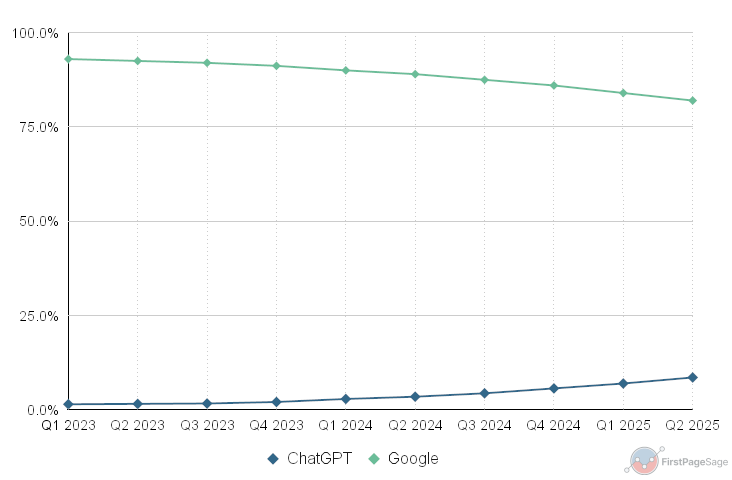
Image: Market share trends for Google and ChatGPT.
Technical Deep Dive: How They "Think"
To truly appreciate the difference, we must look under the hood. Google’s traditional search relies on crawlers—automated bots that scan billions of web pages. Its core algorithm, famously rooted in PageRank, evaluates the authority and relevance of these pages based on links, keywords, and user behavior. When you search Google, you are essentially asking a librarian to find the most relevant books in a massive, ever-growing library.
ChatGPT, conversely, is built on Large Language Models (LLMs). It doesn't "search" in the traditional sense; it predicts the next word in a sequence based on patterns learned during its training on a massive corpus of text. When it "searches" the web today, it uses a hybrid approach: retrieving relevant text snippets and then using its reasoning capabilities to synthesize a coherent response. This is more akin to asking a highly well-read scholar to summarize a topic for you based on everything they’ve ever read.
This fundamental difference explains why Google is superior for navigational queries (e.g., "login to my bank") where accuracy and direct links are non-negotiable, while ChatGPT wins at conceptual queries (e.g., "explain quantum entanglement to a five-year-old") where synthesis and simplification are the primary goals.
Head-to-Head: Performance in Real-World Scenarios
To bring this comparison to life, let's look at how these platforms perform in common daily tasks.

Case Study 1: Planning a Multi-City Trip
If you ask Google to "plan a 10-day trip to Japan," you'll get a list of travel blogs, TripAdvisor links, and flight options. You have to click through each one, take notes, and build your own itinerary.
Ask ChatGPT the same, and it will generate a day-by-day itinerary, suggest specific trains to take, and even estimate a budget. If you tell it, "I don't like sushi," it will instantly rewrite the plan to exclude sushi restaurants. This contextual memory is ChatGPT's secret weapon.
Case Study 2: Debugging Code
A developer facing a "NullPointerException" in Java will find Google useful for finding StackOverflow threads with similar issues. However, they have to adapt those solutions to their specific code.
ChatGPT allows the developer to paste their exact code block. It will identify the specific line causing the error, explain why it's happening, and provide the corrected code. In the realm of technical assistance, the conversational AI is often leagues ahead.
The SEO Ripple Effect: A Changing Web
The rise of AI search isn't just changing how we find information; it's changing how the internet is built. For twenty years, the "deal" between Google and content creators was simple: "You provide high-quality content, and we'll send you traffic."
With AI Overviews and ChatGPT providing direct answers, many users no longer need to click through to websites. This "zero-click" search phenomenon is a major concern for publishers and bloggers. If users get the answer they need directly on the search page, the incentive to create free, high-quality content may diminish. We are seeing a shift toward Information Gain—where only content that provides unique, first-hand experience or data that AI can't easily synthesize will continue to thrive in the rankings.
Privacy, Ethics, and the "Echo Chamber" Risk
As we rely more on AI for answers, we must consider the ethical implications. Google’s search results are, in theory, a reflection of the web's diversity. While not perfect, you can see who wrote an article and what their biases might be.
ChatGPT’s "single source" format can inadvertently create a more powerful echo chamber. If the AI is trained on biased data or programmed with specific guardrails, it may present a narrow view of a topic as the objective truth. Furthermore, the privacy aspect is significant. To provide personalized answers, these AI models often require more data about our preferences and intent than a simple keyword search. As we move into 2026, the transparency of how these models are trained and how they handle our data will be a central pillar of the "Which is better?" debate.
Performance & Impact: Speed, Accuracy, and Environmental Cost
When evaluating these platforms, performance metrics like speed and accuracy are paramount. Google has long been lauded for its near-instantaneous delivery of search results. Its algorithms are optimized for speed, providing relevant links in milliseconds. ChatGPT, while quick to respond, can take several seconds to generate comprehensive answers, especially for complex queries. This difference in speed can be a factor for users seeking immediate, quick-fire information.
Accuracy is another critical area. Google's strength lies in its ability to present a wide array of sources, allowing users to discern accuracy by comparing information. While Google's algorithms are highly sophisticated, the ultimate responsibility for verifying information often rests with the user. ChatGPT, despite its impressive capabilities, still carries a disclaimer regarding the accuracy of its results. As an AI model, it can sometimes "hallucinate" or provide plausible but incorrect information, especially when dealing with obscure facts or highly specialized domains. This necessitates a degree of critical evaluation from the user, particularly for high-stakes information.
Beyond user experience, the environmental impact of these technologies is gaining attention. Processing AI queries, particularly those involving large language models, is significantly more energy-intensive than traditional search queries. Reports suggest that a single ChatGPT query can require nearly ten times as much electricity as a standard Google search. As AI usage scales, this environmental footprint becomes a critical consideration for sustainability in the digital age.
The Future of Discovery: Innovations and Evolution
The competition between ChatGPT and Google is not static; both are continuously innovating. OpenAI's recent developments, such as ChatGPT Atlas and Pulse, signal a move towards more personalized, memory-driven search experiences. Atlas, an AI-powered browser, aims to integrate conversational search directly into browsing, summarizing content and remembering browsing history for smarter follow-up queries. Pulse, on the other hand, delivers personalized research snapshots, proactively pushing relevant summaries and updates to users.
Google is also rapidly evolving its AI capabilities. Beyond AI Overviews, the continuous development of Google Gemini, its multimodal AI model, promises more sophisticated and integrated AI experiences across its product suite. Gemini aims to understand and process information across text, images, audio, and video, potentially offering a more holistic and interactive search experience that could rival or surpass current conversational AI models.

Image: Illustrating the evolution from traditional to AI search.
The future of information discovery appears to be a hybrid model, where the strengths of both traditional indexing and generative AI are combined. We are moving beyond simple keyword matching to a more nuanced understanding of user intent, where conversations and contextual awareness play a central role.
Conclusion: Which Tool is Better?
So, which is better: ChatGPT or Google? The answer, as with many complex technologies, is not a simple either/or. Instead, it's a matter of understanding their distinct strengths and applying the right tool for the right task.
Google remains the undisputed champion for traditional information retrieval: navigational queries, transactional searches, fact-checking, and accessing a broad spectrum of sources. Its vast index, real-time updates, and comprehensive ecosystem of services make it indispensable for daily information needs. For tasks requiring verifiable facts, diverse perspectives, or up-to-the-minute news, Google's traditional search, enhanced by AI Overviews, is still the go-to.
ChatGPT, with its conversational prowess and generative capabilities, excels in tasks requiring creativity, synthesis, explanation, and interactive problem-solving. It's an invaluable assistant for drafting content, brainstorming ideas, learning new concepts through dialogue, and exploring complex subjects in a more engaging way. For those seeking a personalized, interactive, and creative partner, ChatGPT offers an experience that Google cannot fully replicate.
Ultimately, the choice between ChatGPT and Google is not about one replacing the other, but about leveraging their complementary strengths. The most effective approach for the modern digital user is likely a synergistic one: using Google for its unparalleled breadth and authority in indexing the web, and turning to ChatGPT for its depth in conversational AI and content generation. As both technologies continue to advance, they will undoubtedly converge further, offering even more integrated and intelligent ways to discover, create, and interact with information. The era of "blue links" is evolving, but the fundamental need for reliable, accessible, and intelligently presented information remains constant. The future of search is not just about finding answers; it's about understanding, creating, and conversing with knowledge itself.