The Citizen AI Revolution: How to Master Artificial Intelligence Without Writing a Single Line of Code
For decades, the world of Artificial Intelligence was a gated community. To enter, you needed a master’s degree in mathematics, a deep understanding of neural networks, and the ability to write thousands of lines of complex Python code. If you didn't speak the language of algorithms, you were merely a spectator to the most significant technological shift of our time.But the gates have been thrown wide open. We are currently witnessing the "Citizen AI" revolution—a period where the power to build, automate, and innovate with artificial intelligence is moving from the hands of the few into the hands of the many. Today, your most valuable tool for mastering AI isn't a coding IDE; it's your own natural language and creative problem-solving ability.
This shift is more than just a convenience; it is a fundamental democratization of technology. Much like the transition from command-line interfaces to the visual folders of Windows and Mac, or the move from hand-coding HTML to using drag-and-drop website builders, AI is becoming an "invisible" layer that anyone can manipulate.
The New Literacy: Why No-Code is the Future of Innovation
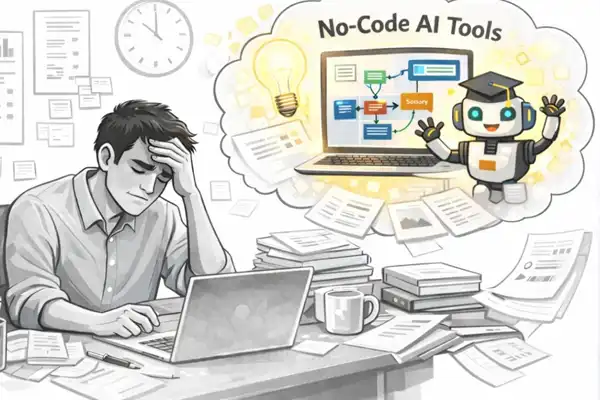
The misconception that AI requires coding stems from a misunderstanding of what AI has become. While the creation of foundational models like GPT-4 or Claude still requires massive engineering feats, the application of these models does not. In fact, the most impactful AI innovations of the next decade will likely come from domain experts—doctors, marketers, lawyers, and teachers—who use no-code tools to solve specific problems in their fields.Learning AI without coding is about shifting your focus from "how the engine works" to "how to drive the car to a specific destination." By abstracting away the technical complexity, you can focus on high-level strategy, creative direction, and operational efficiency. In this new landscape, the ability to clearly articulate a problem and design a workflow is far more valuable than the ability to debug a script.
The Core Pillars of No-Code AI Mastery
To become proficient in AI without coding, you need to master three foundational pillars. These aren't technical skills in the traditional sense, but rather "meta-skills" that allow you to interact effectively with intelligent systems.1. Prompt Engineering: The Art of Structured Communication
Prompt engineering is often dismissed as just "talking to a chatbot," but in reality, it is a sophisticated form of logic and communication. It is the ability to provide a machine with the context, constraints, and instructions it needs to produce a high-quality output.Mastering this skill involves moving beyond simple questions. You must learn techniques like Chain-of-Thought prompting, where you ask the AI to explain its reasoning step-by-step, or Few-Shot prompting, where you provide examples of the desired output format. When you master prompting, you aren't just getting answers; you are programming the AI using human language.
2. AI Workflow Automation: Connecting the Digital Dots
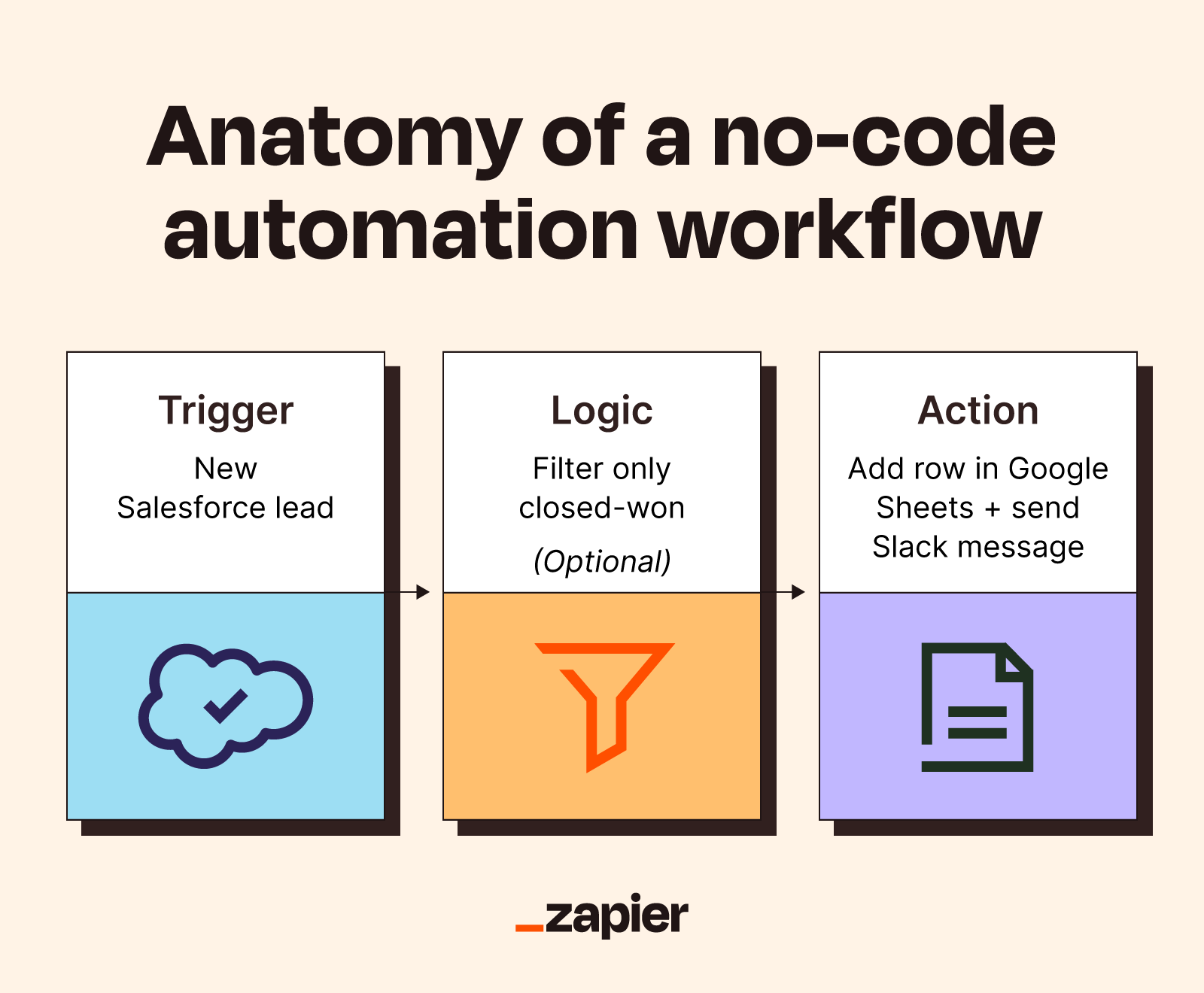
The true power of AI is realized when it isn't used in isolation. No-code automation allows you to connect different AI tools together to create "pipelines." For example, you can build a system where a new customer email triggers an AI to summarize the request, another AI to draft a personalized response, and a third tool to log the interaction in your CRM—all without you lifting a finger.Tools like Zapier and Make.com act as the "glue" for the internet, allowing non-coders to build complex systems that would have previously required a team of developers.
3. Data Literacy and AI Ethics
Even without coding, you must understand the data that fuels AI. This means knowing how to identify "hallucinations" (when an AI confidently states something false), recognizing bias in AI outputs, and understanding the privacy implications of the data you share with these models. A professional AI practitioner knows that the output is only as good as the input and the oversight provided.The 90-Day Roadmap to AI Proficiency
If you are starting from zero, the prospect of "learning AI" can feel overwhelming. However, by following a structured roadmap, you can move from a curious beginner to a capable AI operator in just three months.Month 1: The Foundation (Understanding LLMs and Prompting)
Your first month should be dedicated to understanding the "Big Three" of Large Language Models (LLMs): OpenAI’s ChatGPT, Anthropic’s Claude, and Google’s Gemini.• Week 1-2: Focus on text generation. Use these tools for everything—from drafting emails to summarizing long reports. Experiment with different "personas" for the AI.
• Week 3-4: Dive into Advanced Data Analysis. Most modern LLMs allow you to upload spreadsheets or PDFs. Practice asking the AI to find trends in your data or to turn a 50-page document into a concise executive summary.
Month 2: The Creative Suite (Visual and Multimedia AI)
In the second month, expand your horizon beyond text. AI is revolutionizing how we create images, videos, and audio.• Image Generation: Master tools like Midjourney or Adobe Firefly. Learn how to describe lighting, composition, and artistic style to generate professional-grade visuals for presentations or social media.
• Video and Audio: Explore platforms like Runway for video editing and ElevenLabs for high-quality voice synthesis. The goal is to understand the capabilities and limitations of "Generative Media."
Month 3: The Architect (Building Systems and Agents)
The final month is where you transition from using AI to building with AI.• Custom GPTs and Projects: Use the "builder" interfaces in ChatGPT or Claude to create specialized assistants that are trained on your specific documents and follow your unique instructions.
• No-Code Integration: Start using tools like Zapier to automate a repetitive task in your daily life. This is the stage where you stop "using" AI and start "deploying" it.
The Ultimate No-Code AI Toolkit for 2026
To navigate this journey, you need the right gear. Here is a curated selection of the most powerful no-code AI tools available today, categorized by their primary function.
From Learning to Earning: Career Paths for the No-Code AI Specialist
The most exciting aspect of learning AI without coding is the career flexibility it provides. We are seeing the emergence of entirely new job titles that didn't exist five years ago.• AI Operations Manager: A role focused on integrating AI tools into a company’s existing workflows to increase efficiency and reduce costs.
• Prompt Engineer / AI Content Strategist: Professionals who specialize in guiding AI to produce high-quality, brand-consistent content at scale.
• AI Consultant for Small Businesses: Helping local businesses—from law firms to retail shops—adopt no-code AI tools to compete with larger corporations.
• The AI Solopreneur: Individuals who use AI to handle the work of a 10-person team, allowing them to run successful businesses entirely on their own.
Overcoming the Learning Curve: Tips for Success
The biggest hurdle in learning AI isn't technical; it's psychological. Many people stop because they feel the technology is moving too fast. To stay ahead, adopt a "builder's mindset."1. Don't Just Read, Do: You cannot learn AI by watching YouTube videos alone. You must have the tools open in another tab and follow along.
2. Focus on Problems, Not Tools: Instead of trying to learn every new tool that launches, identify a specific problem in your life (e.g., "I spend too much time on email") and find the AI tool that solves it.
3. Join a Community: The world of no-code AI is incredibly collaborative. Platforms like Discord and LinkedIn are filled with people sharing their "recipes" for success.
Conclusion: Your Seat at the Table of Innovation
We are living through a unique moment in history where the barrier between a great idea and its execution is thinner than ever before. You no longer need to wait for a developer to build your vision; you have the tools to build it yourself.Learning AI without coding isn't about taking a shortcut; it's about choosing a different, more accessible path to mastery. It's about recognizing that in the age of intelligence, your value lies in your ability to think, to create, and to lead. The tools are ready. The question is: what will you build with them?